

If you or one of your relatives ever lived, worked, or retired in the Sunshine State, then this article is for you. That’s because there’s a good chance the state government is holding some of your forgotten cash in the Florida unclaimed property division.
Yes, people really do forget about or lose track of their own money for a lot of different reasons. And it happens more often than you might think. In fact, as of 2026, the Florida Department of Financial Services (DFS) has over $3 billion in unclaimed financial assets.
This missing money belongs to everyday people. It includes everything from forgotten utility deposits to uncashed payroll checks to unclaimed inheritances (and much more).
Fortunately, claiming your share is easier and faster than ever. In this article, I’ll explain exactly what you need to do to check if Florida has some of your unclaimed money and what to do to get it back in your pocket.
But first, let’s review some quick facts that really put into perspective the whole idea of unclaimed money in Florida.
Quick Takeaways
- Incredible 1-in-5 Odds: Approximately 20 percent of Floridians have unclaimed money waiting for them.
- There’s a LOT of Money Involved: Florida returned $800+ million to owners last fiscal year.
- 100% Free to Search: Official state searches and claims won’t cost you a dime. You don’t need to pay a private “asset locator” to find or recover your money.
- Proactive State Refunds: Florida is serious about returning funds. The state recently launched a new “Claim Your Cash Florida” public awareness campaign and website, making it easier for Floridians to claim their assets.
What exactly is Florida unclaimed property?
In legal terms, Florida’s Chapter 717 state statutes govern the system. When a business loses contact with you, they cannot simply keep your assets. This includes businesses like banks, utilities, former employers, or insurance companies.
After a set period of inactivity (known as the “dormancy period”), businesses are legally required to turn funds over to the state. The dormancy period ranges anywhere from as little as six months all the way up to 15 years.
For example, the dormancy period for most bank accounts is five years. However, some items move much faster. For example, uncashed payroll checks are turned over to the state after just one year of no contact.
The state acts as a permanent custodian. Florida holds unclaimed property until the rightful owner, or their legal heirs come forward to claim it.
Common examples of what the state is holding include:
- Money from forgotten savings and checking accounts.
- Unclaimed insurance benefits or matured policies.
- Security deposits from old apartments or utility companies.
- Uncashed paychecks, commissions, or business refunds.
- Stocks, bonds, and mutual funds.
- The contents of abandoned safe deposit boxes (including jewelry, historical documents, and collectible coins).
Note: You won’t find real estate and abandoned vehicles in Florida’s unclaimed property database. This search is strictly for forgotten financial accounts and certain valuables (such as those left in safe deposit boxes).
Why does Florida have so much unclaimed money?
Florida has a highly unique population. The state has millions of seasonal residents (“snowbirds”), retirees, and transient workers moving in and out every year.
When people relocate to a new state or change addresses within Florida, they often forget to update their contact information with financial institutions or other companies they do business with. Companies must perform due diligence to contact you about your inactive accounts. However, if a company cannot contact you after the dormancy period expires, they send your money to the state for safekeeping.
Because of this constant influx of people, the Florida treasury receives millions of dollars in newly abandoned funds every single month. Even if you only lived in Florida for a short-term winter job or a college semester years ago, it’s worth taking five minutes to check to see if you have some money due you.
Step-by-Step: How to search for your Florida unclaimed property
I’ve reviewed several state property search portals over the last year while writing my series of articles about unclaimed money.
I have to say Florida has one of the more user-friendly search systems I’ve encountered thus far.
I went through as much of the search process as I could to document it for this article. Below are a few things I think you should be aware of when conducting your search.
Step 1: Go to the Official Search Portal
Always ensure you’re accessing the official, secure state-run website. The only legitimate search portal is ClaimYourCashFL.gov. Avoid searching on generic commercial sites. They might try to charge you a fee or harvest your personal information.
If you’re not certain you’re on the official Florida website, check for the Florida Department of Financial Services seal. Also, according to the Department, they don’t text people about abandoned property. If you suspect someone is trying to scam you, report it as soon as possible to the Florida Department of Financial Services.
Here’s a screen shot of what Florida’s Claim Your Cash home page looked like on the day I searched:

Step 2: Enter Your Search Terms Creatively
Click the “Search” button on the Claim Your Cash Florida website.
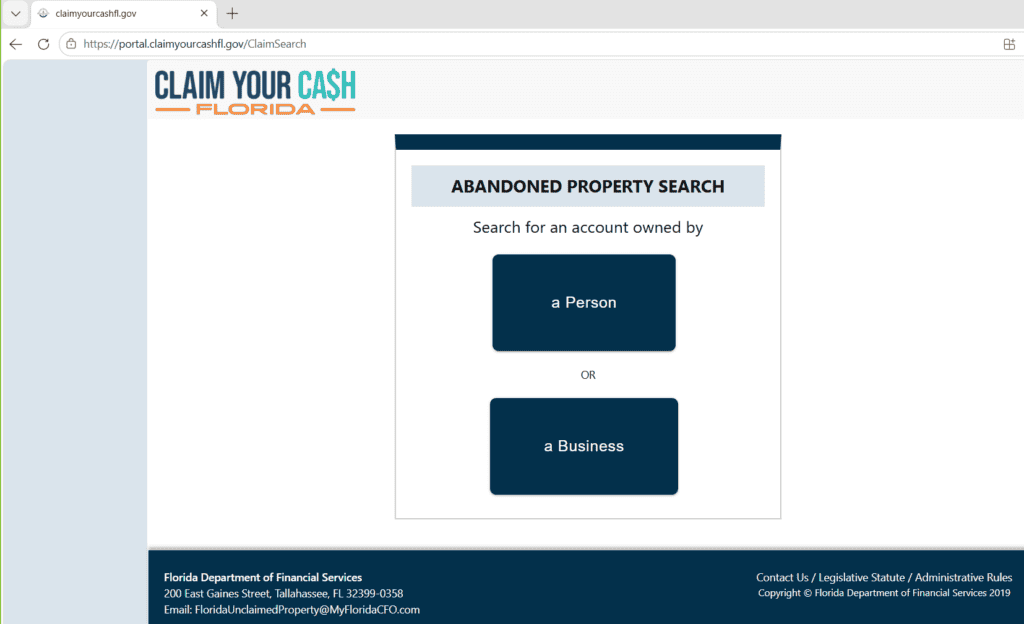
You’ll see this screen prompting you to search for an account owned by a person or a business. If you’ve owned a business in Florida, you can search for unclaimed property owed to your business.
For my search, I selected “Person.”
You’ll then be taken to the “Abandoned Property Search” screen. You need to use this screen to search the unclaimed property database.
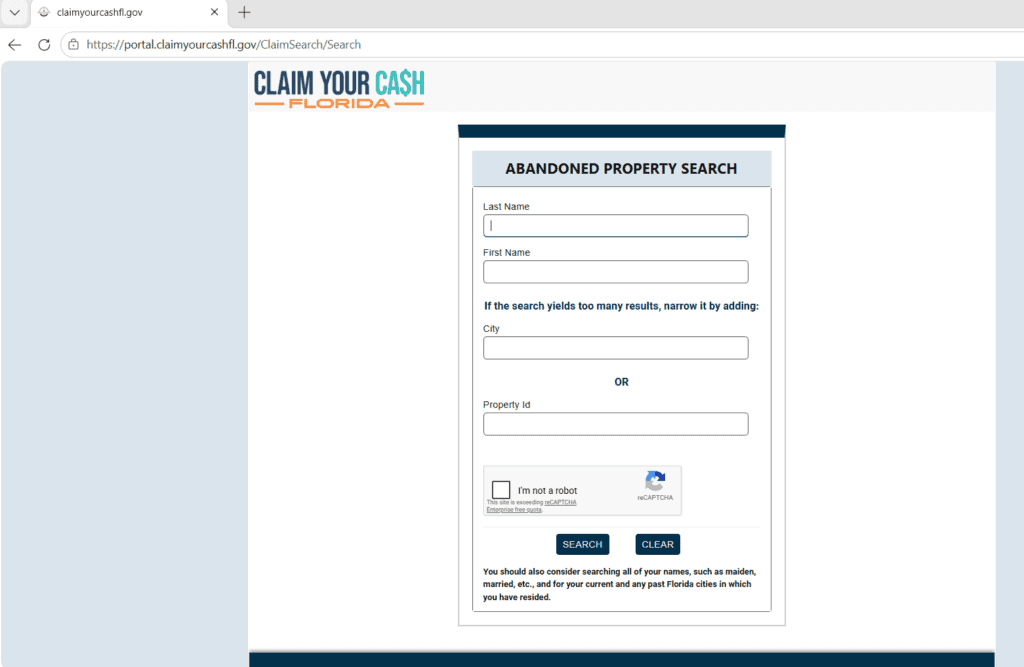
Type your last name and first name into the search bar. You should try a few variations to maximize your chances of finding a property that belongs to you.
- Search past names: Include maiden names, names from previous marriages, nicknames, or names you might have gone by in the past when dealing with businesses.
- Try middle initials: Search with and without your middle initial (e.g., “Robert J. Smith” vs. “Robert Smith”).
- Check deceased relatives: You might be the legal heir to a parent or grandparent’s forgotten estate.
- Narrow your search: Add in the city where you or the person you’re searching for resided. If you received a letter from the Florida Department of Financial Services with a Property ID number, you can enter it here.
Step 3: Review and Claim Your Property
Click “Search” and the system will return a screen with properties matching your criteria. The screen shows the name of the property owner, last known address, and the reporting entity (the business that turned the property over to the state). It also lists the property type (such as refunds, insurance benefits, wages, pension payments, etc.).
Unlike some other states, Florida does not list the value of the property at this point in the claims process. After you submit proof of ownership, the Department of Financial Services will inform you of the property value.
If you find a property you believe is yours, click the “Claim” button next to the property. You can claim multiple properties simultaneously. After you’ve claimed your properties, click the “Claimed Property Cart” button.
Step 4: Complete the Form and Submit the Required Documentation
The DFS will provide you with a claim form you’ll need to complete and submit. The form will have specific instructions, including a checklist of documents you’ll need to submit with your claim.
The DFS needs to ensure they return the property to the rightful owner or heir. Because of this, it’s important to follow the instructions carefully and submit the correct documents that prove you are the rightful owner.
There is no “one-size-fits-all” for the type of documentation you’ll need to submit.
For simple individual claims, you may need to submit your government-issued photo identification, Social Security number, and current address.
If the claim is more complex (such as claiming money on behalf of an estate or a business), your checklist of documents might be more detailed.
Here are examples of the types of documents you might need to submit:
- Proof of current mailing address.
- A government-issued photo ID. This might include a driver’s license, state ID card, passport, or military ID.
- Proof connecting you to the property, such as bank statements, employment records, or proof of your previous address.
- If you’re an heir or estate representative making a claim, you might need to provide a certified death certificate or probate documents.
Once you’ve gathered all the required documents and completed the claim form, mail everything to the address provided on the form.
Step 5: Check Your Claim Status
To see if the DFS received your claim, go to the Claim Status portal. Use your claim number to check the status of your claim.
Don’t be surprised if it takes some time for DFS to process your claim. They receive thousands of claims each month, which the state processes in the order they are received.
They don’t list average times on their website for processing claims. They do state that incomplete paperwork is the cause of most delays. So, it’s a good idea to double check your claim for accuracy before submitting it.
If the DFS approves your claim, you’ll receive an official State of Florida check sent through the U.S. mail to the address verified on your claim form.
FAQ: Your Florida Unclaimed Money Questions Answered

Is there a time limit to claim my money in Florida?
No. Florida holds unclaimed property in perpetuity. It doesn’t matter if the state received the money last year or twenty years ago. Your unclaimed money will remain with the state waiting for you or your legal heirs to claim it.
Will I have to pay a fee to reclaim my property?
No. The state of Florida does not charge any fees to search for or recover your assets. Third-party “asset locators” may contact you offering to recover your money for a commission. However, you can easily do it yourself directly through the Claim Your Cash Florida website for free.
What if I no longer live in Florida? Can I still get my money back?
It doesn’t matter if you now live in another state or even another country. If the money was originally earned or deposited while you were in Florida, the funds stay with the Florida Department of Financial Services until you claim them.
What happens to safe deposit box items?
According to Florida law, the Division of Unclaimed Property can auction off abandoned safe deposit box items two years after the Division receives it. The Division receives the contents of abandoned safe deposit boxes approximately three years after the box rent remains unpaid.
During the time the Division has the abandoned safe deposit box items, they are responsible for safeguarding the items while they attempt to locate the rightful owner.
After approximately two years, the state holds a public auction, selling the abandoned items to the highest bidder. The Division then holds the proceeds until the owner or heir makes a claim.
Does Florida pay interest on unclaimed property?
No, Florida does not pay interest on unclaimed property. According to Florida law, the Department of Financial Services only returns to the rightful owner the amount originally received by the state.
Florida deposits the unclaimed cash into the State School Fund for use by the public school system. According to the Claim Your Cash FAQs:
“…this does not affect an owner’s ability to recover their property. The owner remains entitled to claim the full amount reported to the State.”
Unlock your “mini windfall” today
With over $3 billion sitting in the state vault and a one-in-five chance of finding a match, searching for Florida unclaimed property is one of the smartest financial tasks you can complete. It only takes a few minutes, costs absolutely nothing, and could provide you with some extra cash.
Even if you don’t find anything for yourself, you can share this information with friends and family members who have lived in or are currently living in Florida. I would say most folks would be delighted to find a bit of unexpected, windfall wealth coming their way!
And as I mentioned earlier, it’s not just Florida that is handing back money to its rightful owners. Every state in the union has an unclaimed property division. I’ve written about unclaimed property in California. I’ve shown you step-by-step instructions for claiming property in Texas. And New York is another fine example of a state that is actively looking to return unclaimed money.