

Do you suspect you might have some unclaimed property in California? Maybe at one point in your life, you lived in the Golden State? Or maybe you still do. Or maybe you have family members who’ve lived in California?
Whatever the case, the California State Controller’s Office (SCO) just might be holding some money or other assets that rightfully belong to you. And if that’s the case, you’re not alone.
The SCO says they’ve got over $15 billion in assets just waiting to be distributed to folks who are unaware they have anything owed them. On any given day, the SCO returns over $1 million in lost money or assets to their rightful owners. In fiscal year 2024-25 alone, the state returned over $534 million worth of unclaimed property.
So, if you’re interested in hidden treasures, you just might want to learn more about California’s unclaimed property process.
What is unclaimed property in California?
You may not have heard of the word “escheat,” but it plays a big part in why property belonging to other people winds up in government possession.
Escheat refers to the process where a government obtains possession of a financial asset due to a lack of activity related to the asset and the inability to locate the asset’s owner.
For example, let’s say a business like a utility company or a bank loses contact with you for a few years. Your account is dormant without any activity, and the company has unsuccessfully tried to contact you.
If there’s any money in the account, the business isn’t allowed to keep it. By law, after a designated time, the business must turn those funds over to the government for safekeeping.
Each U.S. state has its own procedures for handling unclaimed property. In California, it’s the State Controller’s Office (SCO) that handles the process.
Examples of unclaimed property in California
While the SCO does not hold unclaimed cars or real estate, they do hold custody of a substantial amount of other property types.
Here are a few common types of unclaimed property:
- Forgotten savings or checking accounts.
- Uncashed payroll checks or commissions.
- Security deposits from old apartments or utility companies.
- The contents of forgotten safe deposit boxes (including jewelry, precious metals, and family heirlooms).
- Insurance benefits or death benefits.
- Stocks, bonds, mutual funds, certificates of deposit, dividend payments.
- Trust funds and escrow accounts.
How to find and claim your unclaimed property in California
Ready to see if you’re one of the lucky ones? Follow these simple steps to search the California SCO database.
Step 1: Visit the Official “Claim It” Portal
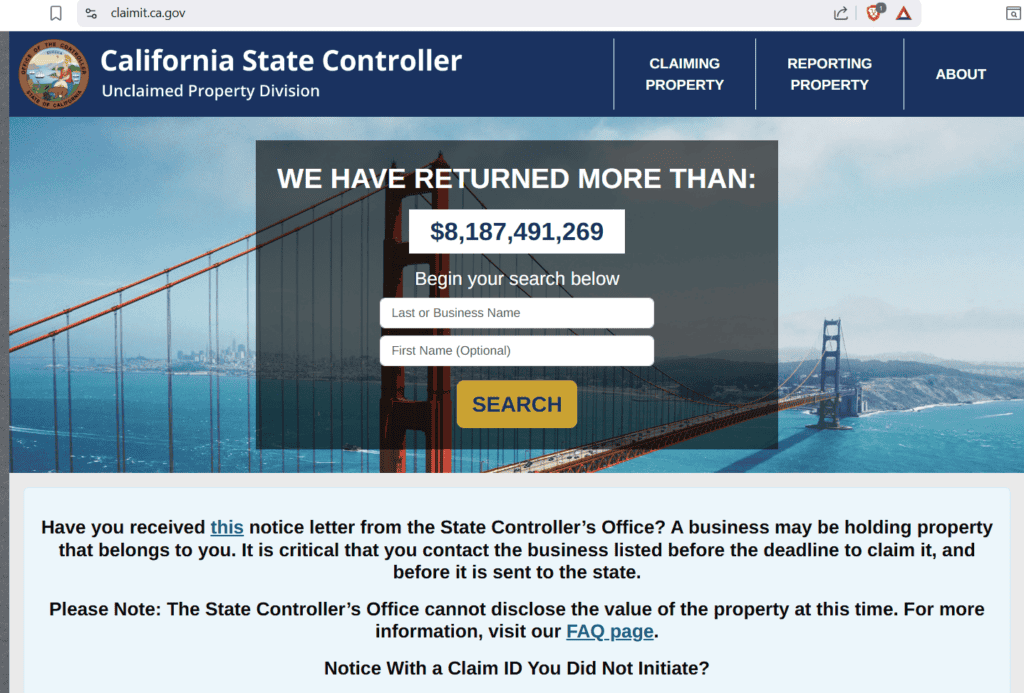
Always ensure you are on a .gov website. The only official site for California unclaimed property is https://claimit.ca.gov/.
Avoid any site that asks for a credit card or a search fee. You do not need to pay a fee to search for or claim your property. The official California State Controller website is 100% free.
Here’s what the site looks like as of the publishing of this article:
Step 2: Enter Your Information
On the search page, the very minimum you’ll need to enter is your last name or business name. However, to really narrow down your search, you can enter additional information on the page that follows. There you’ll be allowed to enter a city, zip code, and property id code (if you have one).
Here are some additional tips:
- Search Maiden Names, Legal Name Changes: If you’ve changed your name, search your previous one.
- Check Relatives: Search for the names of parents, grandparents, or other relatives who have passed away. You may be their legal heir.
- Try Common Misspellings: Sometimes a business will enter data incorrectly into their system. If your name is “John Smith,” try “Jon Smith.”
Step 3: Review the Results
The results will show you a list of names and last known addresses. It will show the holder’s name, which is the company that originally held the asset. The system will also include the dollar amount being held, a property ID, and a description of the asset.
If you see an address where you used to live and/or recognize an asset you believe is yours, click the “Claim” button next to that property. If you find several properties that belong to you, click the “Claim” button next to each property. To continue the claim process, select the “Continue to File Claim” button.
Step 4: File Your Claim
You’ll then be taken to a page where you’ll need to select your relationship to the property (such as owner, heir, trustee, executor, etc.). The system will prompt you to enter your name and email contact information. You’ll need to verify your mailing address to ensure the state sends your check to the correct address. You’ll then submit your claim to the State Controller’s office for review.
Step 5: Submit Your Documentation
The Controller’s Office may need you to submit additional documents before processing your claim. If this is the case, you’ll receive an email stating what documents you’ll need to submit. They could ask for your Social Security information, driver’s license, or other documentation.
You can either upload your documents directly to the state via a secure link or you can mail them to the State Controller’s Office.
How to claim your property video
This helpful tutorial from the California State Controller’s Office takes you through the process of claiming your property:
What happens after you file?
Once you submit your claim for California unclaimed property, you’ll want to check your claim status using your claim number. You can find your claim number on your claim form and in the email the State Controller’s Office sends you after you submit your claim.
To find out your claim’s status, enter your claim number on the Search For Your Claim’s Status page.
How long does it take to process claims?
The California State Controller’s Office says that property owners with simple claims that only involve cash may receive their funds in as little as 30 to 60 days.
Complex claims may take longer to process. These claims might involve multiple owners, heirs, or businesses. California law gives the state 180 days from the date it receives the completed claim package to decide whether to honor the claim.
If the SCO approves the claim, they will mail a check to the address you provide on the claim form.
What’s the controversy with the system for unclaimed property in California?
Critics say California should have a process for automatically returning unclaimed property to its owners. Instead, the current system relies on people searching for their property on the state’s unclaimed property website.
The problem is that many Californians don’t know about the website. Nor do they know they might have money or other assets waiting for them to claim.
This money represents a source of windfall wealth that financially struggling Californians, including nonprofits, could certainly use. Instead, the money sits in the state’s possession, earning interest.
Now, you might think the interest goes back into the unclaimed account, waiting for the rightful owner to claim it. But you’d be wrong.
California turns the interest over to the General Fund, which uses the money for state expenditures. Should the rightful owner eventually claim their property, they will only receive the initial value of their property, not the interest accrued.
Given that the value of California unclaimed property is $15 billion, that’s a lot of interest going directly to the state. According to a CBS news investigative report, interest adds about $1 billion in yearly revenue to the state’s coffers.
And this is why some critics believe the state is dragging its feet on improving its system.
A better strategy for unclaimed property in California
California’s process is in stark contrast to some states that automatically return unclaimed property to their rightful owners.
That’s what North Dakota recently started doing. The state passed legislation allowing their Unclaimed Property Division to match updated address information with property owners. After a strict verification process, the state automatically returns up to $1,000 by mailing a check to the rightful owner.
Other states are also using new tech tools to proactively verify a property owner’s identity and address before returning unclaimed funds. New York, Pennsylvania, Washington, Oregon and Connecticut have all implemented data matching systems to reunite people with their unclaimed money.
That means no website searching, filing a claim, uploading paperwork, and waiting (sometimes months) before getting your funds. If other states can quickly and easily return money to their rightful owners, it seems like tech-savvy California should be able to do it, too!
A few last words
We all know life happens. People move, change names after marriage, or simply forget to cash a small check. Some folks pass away without a will or written details documenting all their assets. You may not even know you’re the heir to a small (or large) fortune. There are lots of reasons why you might have lost property just waiting for you to claim.
These hidden treasures shouldn’t remain hidden. It’s easy enough to do a quick search on the state’s website to see if you have unclaimed property in California. It takes minutes (if that) to get the results.
It’s free to search for and claim your property. Plus, the state is endeavoring to make the claiming process easier. They process some claims entirely online and payment sometimes results within weeks.
Have you ever successfully claimed cash or other assets through a state’s unclaimed property process? Drop us a line using our Contact Form. We’d love to hear from you about this article or any other topic we’ve covered on Windfall Wealth Report.