

New York’s Office of the State Comptroller (OSC) is actively reuniting lost money with its rightful owners. Last year alone, the OSC returned a record-breaking $633 million of unclaimed money in New York.
In total, the Empire State holds a staggering $20 billion in unclaimed funds, some of which might belong to you. State officials say if you’ve ever lived, worked, or done business in New York, there’s a good chance they’re holding money with your name on it.
From forgotten rent deposits in Brooklyn to old utility refunds in Buffalo to life insurance benefits in Rochester, this mountain of cash is just waiting for its rightful owners to make a claim.
Quick Takeaways
- Record-Breaking Amounts Returned: On average, the New York State Comptroller returns $2 million every business day to residents, former residents, or their heirs.
- New Fast Payment Program: The State Comptroller now mails checks for newly reported accounts of $250 or less to eligible individuals without having to file a claim.
- No Expiration Date: Unlike some legal claims, your right to unclaimed money in New York never expires. The state holds the funds indefinitely for you or your heirs.
- Completely Free: Searches and claims for lost money through the State Comptroller’s official site are always free. You do not need to pay a “finder” or “investigator” to help with your search or claims process.
What is New York unclaimed property?
In New York, you might hear the phrase “unclaimed property,” “unclaimed money,” or “unclaimed funds.” They all refer to financial assets that have been dormant or inactive for a certain period. The time varies depending on the type of financial asset, although one to three years is common.
Property becomes unclaimed when the property holder loses track of the property owner. The holder is the company or business that currently holds the financial asset on behalf of the owner.
Think of it this way…
Suppose you have a savings or checking account with a bank. You have a business relationship with the bank, which acts as the holder of the account on your behalf.
After a while, you move and forget to update your address with the bank. Maybe you didn’t use the account very often, so you forget about it. The bank tries to contact you, but they don’t have your address.
So, after time, they label the account “dormant” or maybe even “abandoned.” Legally, they must turn these funds over to the New York State Comptroller. The Comptroller now becomes the custodian of your money, holding it for you until you claim it.
But it’s not just banks that turn your money over to the Comptroller. All kinds of companies you do business with or have a financial relationship with might end up turning your money over to the state.
Types of unclaimed money in New York
Forgotten bank accounts are just the tip of the iceberg when it comes to unclaimed money in New York. There are other types of accounts and financial assets that belong to you that the state might hold. You might not realize these assets even exist.
Common types of unclaimed property include:
- Bank Accounts: Forgotten savings, checking, and certificates of deposits (CDs).
- Utility Deposits: Refunds from telephone, gas, or electric companies after you moved.
- Dividends, Stocks, Bonds, Mutual Funds: Unclaimed shares or dividend checks.
- Wages, Payroll, and Salaries: Uncashed checks from former employers.
- Insurance Benefits: Payouts from life insurance policies you might not have known existed.
- Estate Proceeds: Money left behind by deceased relatives.
Step-by-Step: How to search for unclaimed money in New York
1. Visit the Official Search Portal
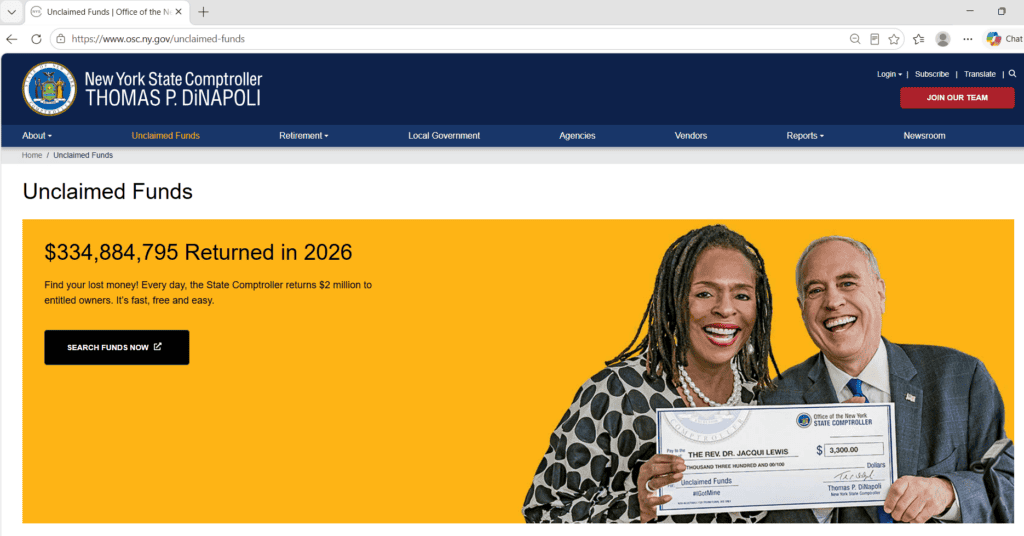
You’ll want to go directly to the Unclaimed Funds page of the Office of the State Comptroller’s website. This is the only legitimate place to search for New York unclaimed property.
Below is a screenshot of what the site looked like on the day I visited it:
2. Begin Your Search
Select the “Search Funds Now” button. You’ll then be taken to the “Search for Unclaimed Property” screen:
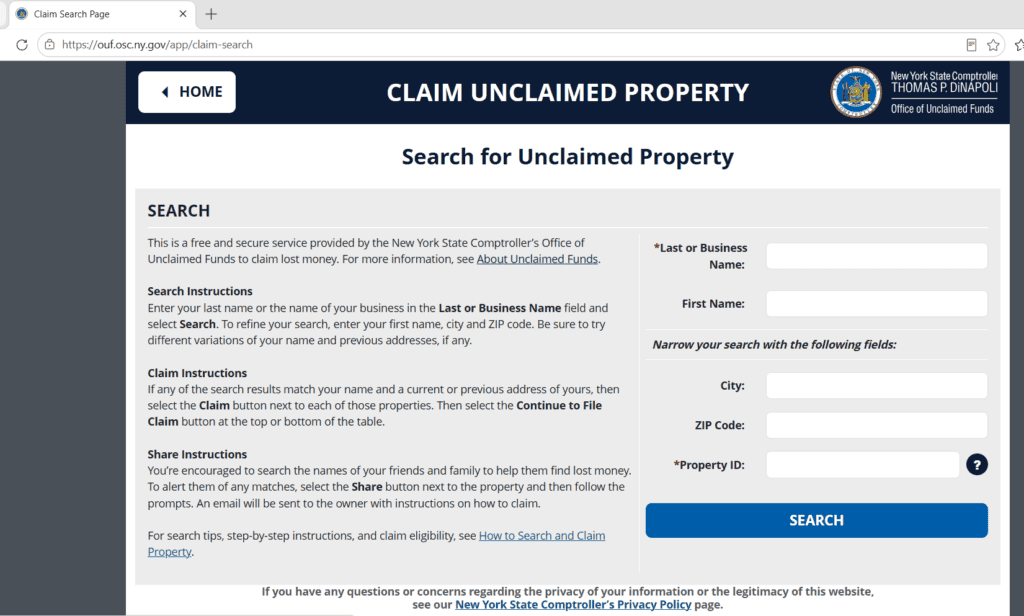
On this screen, you’ll enter your last and first names (or business name).
Search tips:
- Refine Your Results: Use the city or zip code fields to narrow down your search.
- Check Variations: Search for nicknames, common misspellings, or your maiden name.
- Search for Others: The State encourages you to search for friends and family by entering their information into the search form.
3. Identify and Select Your Items
Once you’ve filled in the fields on the search form, click “Search.”
The search results will show a list of unclaimed properties that might be possible matches. You’ll see exact matches first followed by partial matches.
For each unclaimed property, the report provides the name of the owner, co-owner name (if any), the last known address, the reporting business name, the property type, and the year reported. For each unclaimed property, the state assigns a property ID number for tracking purposes.
One interesting thing I noticed about New York’s property search was that the report does not list the value of the unclaimed property. This differs from a few other states I’ve researched.
For example, if you do a search for unclaimed property in California, you’ll see the property value listed in the search results. Texas is another state that lists the dollar value of its unclaimed property.
In New York, you won’t discover the value of your property until after the state reviews your claim. The state says this is to prevent fraud.
The downside of not knowing the value of the property is that you could end up spending time on a claim that is worth very little. If the property is only worth a few dollars, it would be nice to know in advance before you put in the effort to make a claim.
If you see a property (or properties) you’re entitled to, click the “Claim” button next to each of the properties. Then click “Continue to File a Claim.”
If you find a match for a friend or relative, click the “Share” button. This will allow you to alert them that they might have some lost money waiting for them. Follow the prompts and the system will email them instructions on how to claim their money.
4. File Your Claim Online
For most claims, you’ll be able to complete the entire process online. For each property, you’ll need to identify your relationship to the owner. If you are the owner, you’ll choose “Owner (Self).”
If you are the owner’s representative (guardian or trustee, for example), choose the appropriate relationship in the Claimant Relationship dropdown box. Do this for each property.
At the bottom of the screen, select “File a Claim.”
You’ll then be prompted to provide your name, contact information, date of birth, and Social Security number. Provide the mailing address where you want to receive your check if the State Comptroller’s Office approves your claim.
You’ll then need to review the accuracy of your claim, electronically sign it, and click the Submit button.
NOTE: There are specific instructions you’ll need to follow if one or more of the following is true:
- You are claiming on a deceased owner’s account or on behalf of another person.
- You are claiming as the owner of a U.S. business.
- You do not wish to provide your Social Security number.
- You were notified that your property was turned over to the state, but you can’t locate it in the database.
For information about the above situations and answers to other questions, be sure to review the “How to Search & Claim Property” page.
TIP: If you think you might have unclaimed money in other states, check out our Unclaimed Money archive for state-specific articles to help your search.
What happens after you file?
Within 48 hours of submitting your claim online, you should receive an email from the Comptroller’s office. The email will let you know if you need to submit additional information to verify and process your claim.
For simple claims, the email might say there are no further actions needed on your part. If the state approves your claim, they will email you details about the payment. This will include the amount and information about when you can expect your check. Generally, you can expect to receive your check mailed to the address you provided within 30 days.
More complex claims (those filed by heirs of a deceased owner or on behalf of someone else) may take longer to process. These claims may require you to submit more documentation to help the state verify your right to the money. It may take the state 90 days to review your claim after they receive the documentation.
At any time, you can check the status of your claim by going to the Claim Status Search Page and entering your Claim ID number. You can find your Claim ID on your claim form or in the email you received from the Comptroller.
NOTE: If you receive a letter or a check in the mail from the New York State Comptroller and you didn’t file a claim, don’t throw it away! This is part of the state’s new expedited payment program, where they proactively mail checks to residents they can verify through other state databases.
Start your search for New York unclaimed money today!
With over 50 million individual accounts currently in the database, the state is essentially running a large “lost and found.” And some of that money has been sitting there for a long time. The day I searched the database, I saw accounts dating back to 1997. New York Comptroller Thomas P. DiNapoli says some accounts go back to the 1940s!
Even if you lived in New York for just a few months, it is worth a five-minute search. With $20 billion waiting in Albany, the odds are in your favor you might find something for yourself, a relative, or friend. Whether it’s a forgotten $20 utility refund or a $2,000 inheritance, that money belongs to you, not the state’s general fund.