
You probably don’t think twice about the pennies in your life. For most folks, a penny is the definition of small change. They end up at the bottom of your purse or hiding in couch cushions. But every so often, a rare penny sells at auction for more than a new car, a year’s salary, or even a house.
And, of course, that’s when things get really exciting!
When news of a super-charged penny auction spreads, people begin to see pennies in a whole new light. What was once not worth bending down to pick up, now becomes a source of fascination and speculation.
Three stories of pennies worth THOUSANDS of dollars
In the world of coin collecting, a few things need to combine to turn one cent into a six-figure asset. In my recent research on the topic, I’ve seen things like mint errors, low mintage, and collector demand as big factors in these stories.
And what makes these stories so compelling (at least to me!) is that many of these coins didn’t start life in a bank vault or a millionaire’s display case. They began exactly where most coins are now. These rare pennies are in circulation at your local grocery store, in pocket change, and stuffed in your kid’s piggy bank.
Here are three real world examples of how a rare penny went in the blink of an eye from virtually worthless to windfall wealth. I’ll wind up my coverage with a few tips to help you spot and cash in on these valuable coins.
Story 1: The 1955 “seeing double” rare penny worth six figures
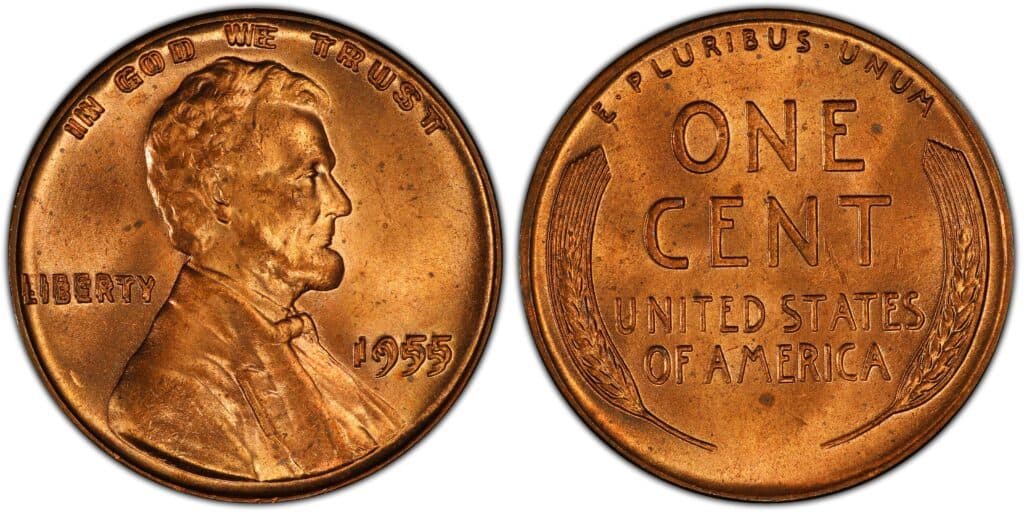
The year was 1955 when the United States minted one of the most famous rare pennies of all time. A minting error at the Philadelphia Mint created 40,000 “doubled die” obverse one-cent Lincoln coins.
The “doubled die” name refers to a misalignment in the coin die used to create the penny. This misalignment gives the obverse (front side) of the coin an almost 3D effect. This “seeing double” glitch is most noticeable on the date (1955) and the words “Liberty” and “In God We Trust.” (Take a close look at the photo above to see for yourself).
During the press run, an inspector noticed the mistake and destroyed approximately 16,000 of these “bad pennies.” Another 24,000 had already made their way into the system, mixing in with pennies from other press runs. Since there was no easy way to separate out the error coins, they went into circulation. Banks in Massachusetts and New York distributed the coins as they normally would.
At first, people found the coin in pocket change and spent it at face value before anyone realized how unusual it was. Starting in 1958, a market for collecting the coin gained momentum.
Today, that same rare penny has become a legendary prize. Even circulated examples that show wear and tear after spending years changing hands can fetch $1,000 to $10,000 or more.
But the hottest market is for well-preserved examples of the 1955 doubled die Lincoln cent. High-grade pieces sell for six figures at auction. The Professional Coin Grading Service (PCGS) reports a nearly pristine coin sold for an amazing $114,000 in a 2018 auction.
FUN FACT: In 2023, an astonished Kentucky farmer found 800 Civil War-era gold coins buried in his corn field. This amazing find (valued at over $2 million) became known among coin collectors as “The Great Kentucky Hoard.”
Story 2: The 2001 “modern mule” penny worth more than most cars
There’s a misconception that only old coins are valuable. This second story completely shatters that myth.
In 2001, a small number of coins left the Denver Mint with a bizarre mismatch. The front (obverse) side showed Abraham Lincoln. But the back (reverse) side belonged to a Roosevelt dime.
In the previous story, I discussed a minting error called a “doubled die” error. The Denver Mint error, however, is a different kind of minting mistake known as a “mule” error.
Just like a mule is a “hybrid” animal, the 2001 Denver Mint rare penny is a hybrid of mismatched coin designs combining a penny on the front with a dime on the back.
If you want to see what this mule coin looks like, watch this YouTube video. The creator gives a nice closeup of this strange coin.
Was this rare penny accidentally or intentionally created?
Now you might wonder how such an obvious error could occur during the coin fabrication process? And how would the Mint allow the coin to enter circulation?
While I would guess some human inattention to detail was a factor, that’s just my conjecture. Numismatic expert Charles Morgan offers his two cents’ worth (pun intended!) on the topic:
“Without direct evidence, it is impossible to know whether such spectacular Mint errors are intentionally or accidentally struck, or whether they are smuggled out or unintentionally released. Over the years, several curious errors have escaped the Mint, including modern Proof coins struck over obsolete coins, coins with missing edge inscriptions, and “coins” struck on everyday objects, like the undated dime struck on a nail… This 2001-D Lincoln cent mule falls in the category of Mint errors that conceivably could have been produced by mistake and released unnoticed into circulation.”
Charles Morgan, Coin Week, This Rare Lincoln Cent Roosevelt Dime Mule Is Worth $100,000 or More.
Whatever the reason for its existence, a 2001-D Lincoln cent mule is one of the most coveted rare pennies in existence. Coin collectors have paid $66,000, $78,000, and $114,000 in auctions for the coin. Experts say that even a beat-up or low-grade specimen could still pull in tens of thousands of dollars if another one ever surfaced.
Story 3: These “last pennies” sold for a record-breaking $16.7 million
When are Lincoln pennies worth a staggering $16.7 million? When they are the last pennies ever minted by the U.S. Mint!
Now, you might have heard the United States stopped producing one-cent coins in November 2025. This move by the Mint was understandable, given that the cost to produce each penny was 3.69 cents or almost four times its face value. By suspending penny production, the government anticipates it will save about $56 million a year.
To celebrate 232 years of penny manufacturing, the Mint created a limited run of special “last” Lincoln cents packaged in 232 three‑coin sets. Each set featured the following:
- A 2025 penny manufactured at the Philadelphia Mint.
- A 2025-D penny manufactured at the Denver Mint.
- A 2025 penny struck in 99.99% 24-karat gold manufactured at the Philadelphia Mint.
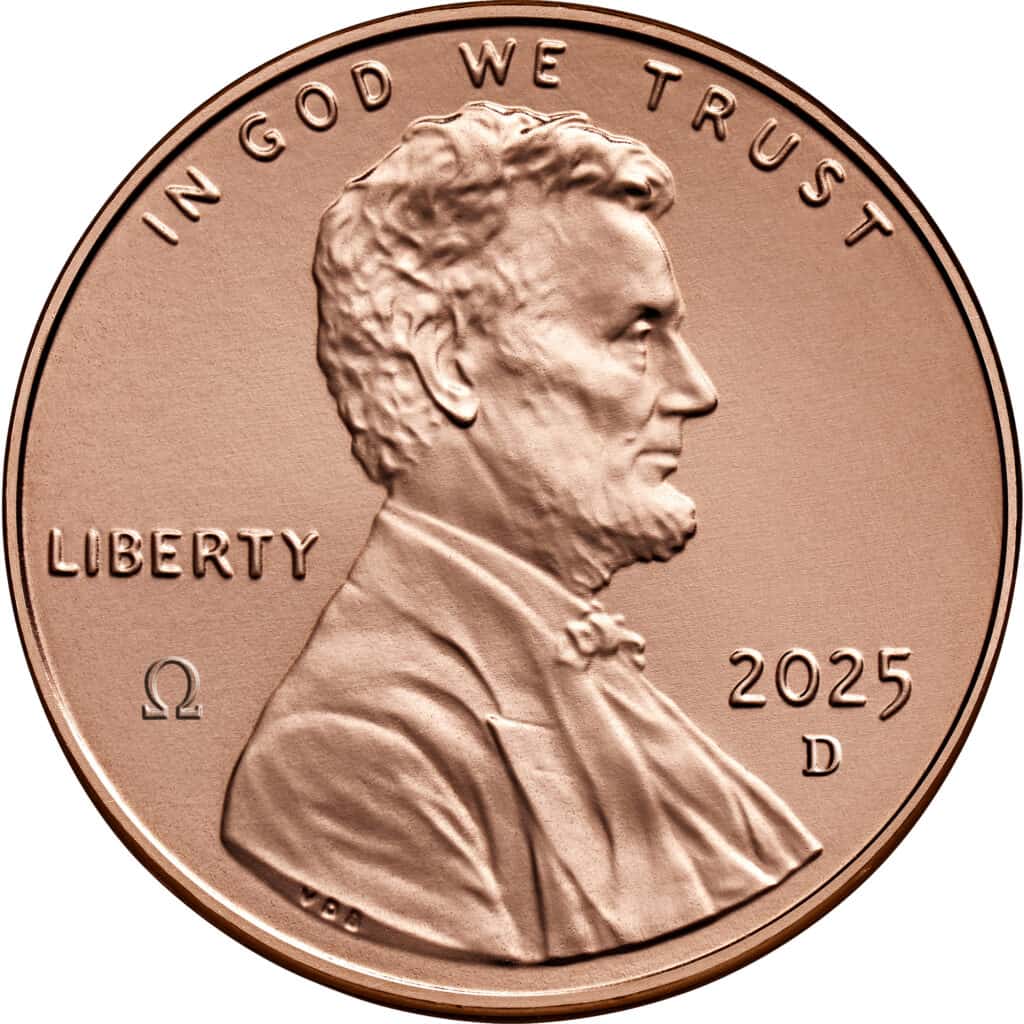
To distinguish them even further, the special coins include an Omega (Ω) mark on the lower left side under the word “Liberty.” Omega is the final letter of the Greek alphabet, thus signifying each coin is among the last of the pennies ever struck by the Mint. Here’s a photo of the 2025-D Omega penny:
So how much does a pretty penny cost?
In December 2025, Stack’s Bowers Galleries held an auction for the “Omega” pennies on behalf of the U.S. Mint. The auction attracted elite coin collectors and the results were stunning. The 232 three‑coin sets sold for a combined total of $16.7 million.
The highly anticipated auction spanned four hours of competitive bidding. As expected, coin set #232 achieved the auction’s top price. Not only were these the last pennies ever minted, but the set included the canceled dies used to manufacture the historic coins. Selling for $800,000, the coin set broke the record for the most valuable modern U.S. numismatic item.
A few tips to help you find your own rare penny
After reading the previous stories, I wouldn’t be surprised if you were tempted to become an avid penny hunter. But before you dump out your change jar in a frenzied search for hidden treasures, here are some tips to help get you started:
- Learn the visual tells of famous error coins like the 1955 doubled‑die or the 2001 mule so you can spot them instantly.
- Pay attention to anything that looks wrong. Look for off‑center strikes, doubled lettering, mismatched designs, or dates and mint marks that don’t seem to fit together.
- For anything unusual, compare your coin against high‑resolution images from reputable coin‑collecting and auction sites. If you suspect you might have a winner, consult a professional grading service for verification.
While most people ignore pennies, the stories of these rare coins are a reminder that value often hides where the crowd isn’t looking. Once in a great while, a rare penny really does go from pocket change to five or six figures. This proves that even the smallest denomination can deliver a very happy surprise!